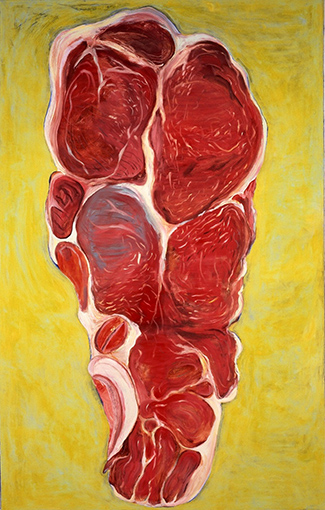
- oil on cotton
73×73cm
- ©HASEGAWA Shigeru
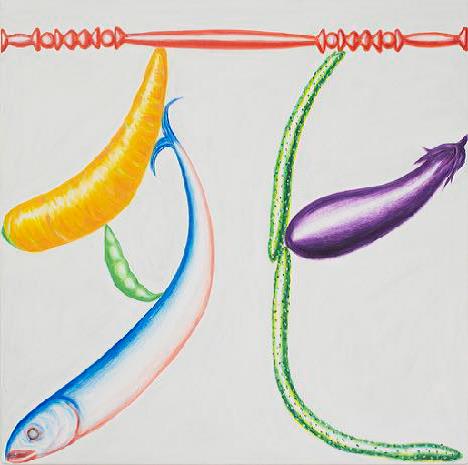
A brightly colored carrot and eggplant are interconnected with flimsy-looking curved cucumbers, an arched fish, and snow peas. The rod-like form at the top may be part of a piece of furniture. The improbably combined, seemingly unrelated subjects together form the kanji character for “death” (shi).
Hasegawa has wrestled with how, as a Japanese artist, he might approach the medium of painting, imported from the West, and make it his own. If we recall that still life painting, which flourished in the Baroque era, often carried the implication of memento mori (“remember that you will die”), we can see in Hasegawa’s response—grounded in that tradition yet marked by his delightfully off-kilter choice of subjects and his all-too-literal depiction of “death”—currents of sorrow and humor as well as a leap into new territory. This work is also a self-portrait, in that Hasegawa, who at one point suspended his activities and underwent death as a painter, identifies himself as Shigeru with the “Shi” in his given name rewritten with the character for death. The luminosity of the surface can also be read as announcing a rebirth from that state.