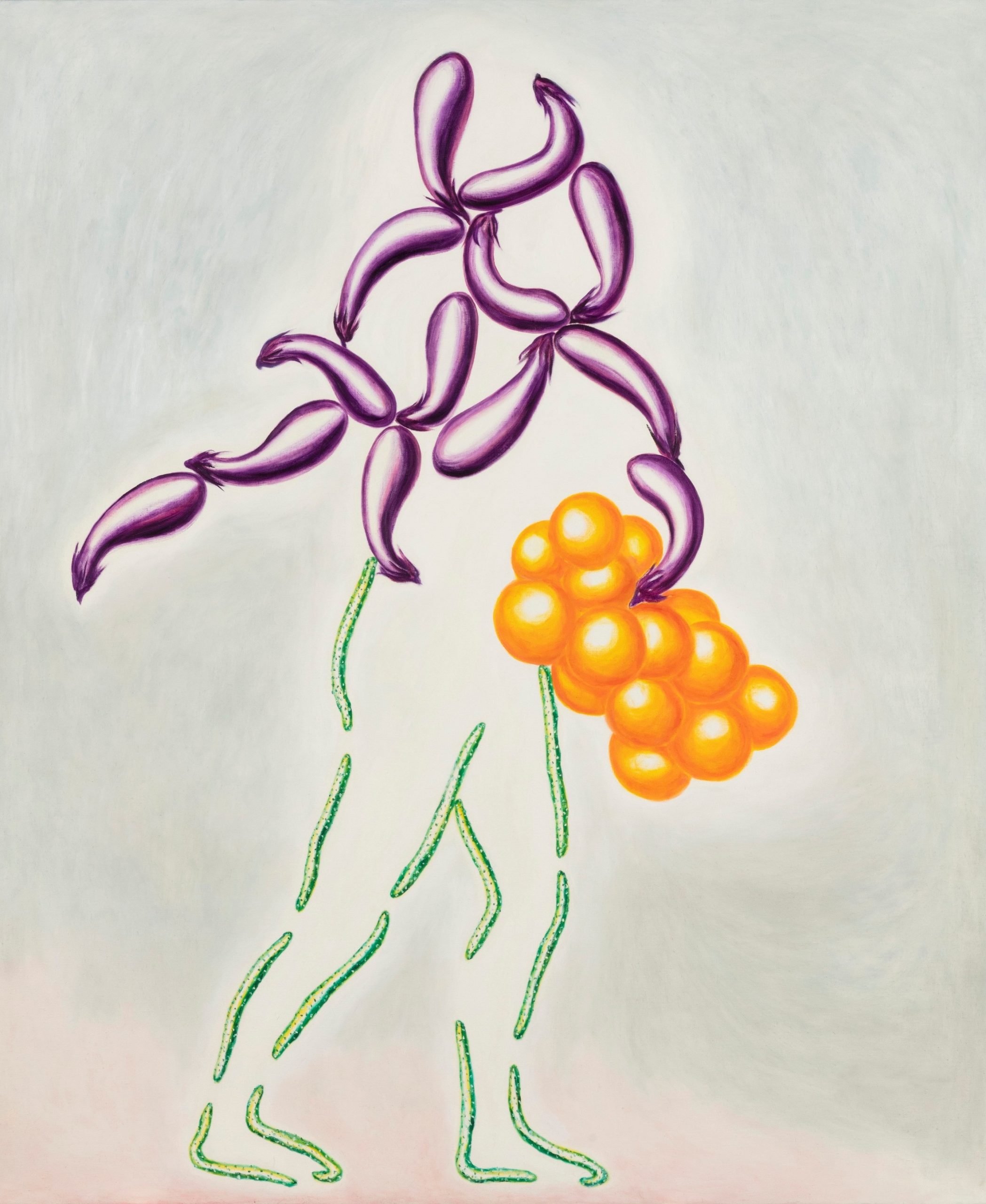
A prisoner of painting? It would be fair to say that Shigeru Hasegawa (b. 1963) is possessed by painting, and lives to paint. That is how much painting fills his mind, perpetually.
On completing a master’s degree at Aichi University of the Arts, Hasegawa moved to Germany in 1989, where he studied under Jan Dibbets at the Kunstakademie Düsseldorf. Confronted by the challenge of pursuing “painting”—a Western tradition—as a Japanese artist, he threw himself into a relentless studio regimen, turning out a rapid succession of oils on paper.Hasegawa’s works of this period are suffused with gloom, evoking stones endlessly piled one on another only to collapse, a child’s soul stacking pebbles in the Sai no Kawara riverbed of Buddhist lore, or the ceaseless agonies of Sisyphus. Having passed through this period of self-mourning to “discard” his previous painting, Hasegawa moved to the Netherlands in 1992, where, following a residency at De Ateliers in Amsterdam, he remained until 1996, in the intervening years finally coming into his own as a painter. Rendered in vigorous strokes on vast canvases over three meters in height were forms that resembled ginger, or the towering pines of fusuma and wall paintings—their sheer strangeness and humor harbingers of an approach to painting that has distinguished Hasegawa’s oeuvre ever since.
The eggplants, cucumbers, bananas, and fish that feature repeatedly in Hasegawa’s works resemble a recasting of the traditional still-life, while Western-derived motifs such as drapery and chair legs serve as freely adaptable elements for constructing the composition—shapes shorn of all meaning. Hasegawa’s audacious attempts to keep painting different pictures with just these limited elements occasionally reach an impasse; prompting a pause in presentation of his works in 2013. Yet during what was to become a lengthy “lying-low,” he continued production, and since returning to solo shows in 2019 has been nothing short of prolific. Hasegawa’s most recent works, created with a bare minimum of rendering using miniscule quantities of pigment stretched economically across the canvas, seem to glow from within, in what—looking back on his journey from the early years of his career, one cannot but see as a startling change.
This exhibition presents a mix of old and new from Hasegawa’s decades of practice, revealing the iron will and agile evolution underlying his work. We also turn our attention to an eye devoted to viewing innumerable works from all eras and cultures, and—separate from his appreciation of more rarefied art—a unique sensibility cultivated in everyday living since childhood. A dedicated room allows visitors to experience this personal realm first-hand through items from our own collection, works by Hasegawa, and an eclectic array of objects he has collected.
| Opening hours |
10:00-17:30 (Admission is until 17:00)
Closed = Mondays (except national holidays)
|